

Why do credit union tellers struggle with complex transactions?
Credit union tellers struggle with complex transactions because they are expected to perform hundreds of complicated, changing procedures, all while delivering a consistent member experience in real time.
In one analysis, we identified over 500 procedures a teller needs to execute at any given time.
No human can realistically memorize and recall that volume of information on demand, especially when the rules and steps are continuously evolving.
At the same time, tellers are under pressure to deliver a seamless, relationship-driven experience. When they are forced to focus on remembering steps, making decisions, and navigating systems, their cognitive load is consumed by the task, not the member.
The result is uncertainty, inconsistent service, and credit union teller errors that impact both the member experience and operational performance.
The real reasons behind credit union teller errors (it's not a people problem)
When credit union teller errors happen, the instinct is often to look at the individual. Training, effort, or experience must be the problem. But in most cases, the problem is not the person. It is the system they are working within.
Tellers are being asked to operate in an environment where complexity, change, and limited access to knowledge make consistent execution extremely difficult.
Procedures are too complex to memorize
Many credit union procedures are far more complex than they appear.
Take something like handling a deceased member account. It involves multiple decision points: Is there a beneficiary? Is it a joint or individual account? What is the account balance? Each answer changes the steps that follow.
This is not a procedure a teller performs every day. It may come up once every few months. So even if they were trained on it, by the time it appears again, much of that knowledge is gone.
And in that moment, the teller is not just completing a transaction. They are supporting a member through a difficult experience. That requires empathy and focus. But instead, their attention is split between helping the member and remembering the correct steps.
Procedures change faster than training can keep up
Even strong training programs cannot keep pace with how quickly procedures change.
Tellers need repetition to learn a process. But just as they begin to internalize it, something changes. It could be a policy update, a system change, or a new requirement. Now the process they just learned is no longer accurate.
Most credit unions cannot realistically retrain everyone every time something changes. Instead, updates are shared through emails or memos. Some employees read them. Fewer internalize them. And even fewer remember them when they are needed.
Knowledge lives in people, not systems
In many credit unions, knowledge is concentrated in a small number of experienced employees.
Everyone knows who that person is. When something unusual comes up, people go to them for answers. In some cases, branches even call other branches to figure out how to handle a situation.
This creates a hidden operational dependency. When that person is unavailable or eventually leaves, the system slows down or breaks.
With many credit unions facing clustered retirements, this is becoming a growing risk.
Existing tools are not built for the teller line
Most credit unions already have documentation. The issue is not whether it exists; it’s whether it can be used in the moment of need.
Tools like SharePoint, shared drives, and PDFs are designed for storage, not real-time execution. They assume the user knows exactly what to search for and has time to read through content.
At the teller line, neither is true.
If a teller cannot find and follow the right procedure in a few seconds, they will default to guessing or asking for help. That is where errors and inconsistencies begin.
What credit union teller errors are actually costing you
These challenges are not just operational. They directly impact member experience, cost structure, and scalability.
Member experience suffers
As one credit union put it: to members, the employees ARE the credit union.
Members do not see your systems or processes. They experience the person in front of them.
When a teller is unsure, gives inconsistent answers, or has to bring in a manager, that experience breaks down. Transactions take longer, confidence drops, and the interaction feels less professional.
It also creates inconsistency. Members may receive different answers depending on who they talk to, creating a kind of “roulette,” where they hope to get someone who knows what to do.
For credit unions, this is especially risky. The member experience is the differentiator. If that becomes inconsistent, the value proposition weakens quickly.
Error remediation costs
Credit union teller errors are not just small mistakes; they create real operational costs.
In one case, a teller followed a procedure incorrectly and accidentally paid off a $10,000 loan that was not actually paid off. The issue was recovered, but it nearly resulted in a direct financial loss.
While not every error is that severe, the pattern is consistent. Each mistake requires:
- Investigation and correction
- Supervisor involvement
- Member communication
Even smaller errors add up quickly when they occur across multiple branches and transactions.
Senior staff bottleneck
Experienced employees often become the unofficial support system for the entire branch.
Their day turns into a constant stream of interruptions—answering questions, validating decisions, and helping others navigate complex situations.
This keeps operations moving, but it comes at a cost. These employees are unable to step into higher-level roles because they are continually pulled back into frontline support.
Over time, this creates frustration and limits organizational growth.
Onboarding drag
It can take 6 to 12 months for a teller to become fully proficient, a timeline we hear consistently across credit unions, depending on role complexity and transaction volume.
During that period, new hires rely heavily on others, move more slowly, and are more likely to make mistakes. This affects staffing flexibility and productivity across the branch.
It also increases turnover risk. When employees feel overwhelmed or unsuccessful early on, they are more likely to leave before reaching full productivity, making each hire more expensive.
Why traditional solutions do not reduce credit union teller errors
Most credit unions have tried to solve this problem. The issue is not effort. It is that the solutions target the wrong problem.
More classroom training is not the answer
Training is often the default response. But there is simply too much information to memorize.
Trying to solve this with training is like pouring a gallon of water into a 16-ounce cup. It will never fit.
Training is valuable for foundational knowledge—understanding products, systems, and how to serve members. But it cannot reliably support the execution of hundreds of procedures in real time.
A shared drive full of PDFs is not the answer
Documentation is not the issue. Usability is.
Tools like SharePoint and PDFs are not designed for the moment of performance. They are difficult to search, difficult to scan, and difficult to follow in real time.
Even when the right information exists, it is often not accessible in the moment it is needed.
Hiring more experienced tellers is not the answer
Hiring experienced tellers feels like a shortcut, but it is not scalable.
Experienced employees are hard to find, and even they need to learn your specific systems and processes. Every credit union operates differently.
The better approach is not to rely on finding people who already know everything. It is to build a system where anyone can perform effectively.
What actually works — from memorization to real-time performance support
At some point, credit unions have to stop trying to solve this with more memorization and start solving it with better support.
The shift is from memorization to real-time performance support.
Instead of expecting employees to learn and retain hundreds of procedures, the goal is to help them master one skill: how to find the right information and follow it while serving the member.
This is the Find & Follow Framework.
The Find & Follow Framework is a knowledge operations approach where employees are trained to quickly find the right procedure and follow step-by-step guidance in real time, rather than relying on memory.
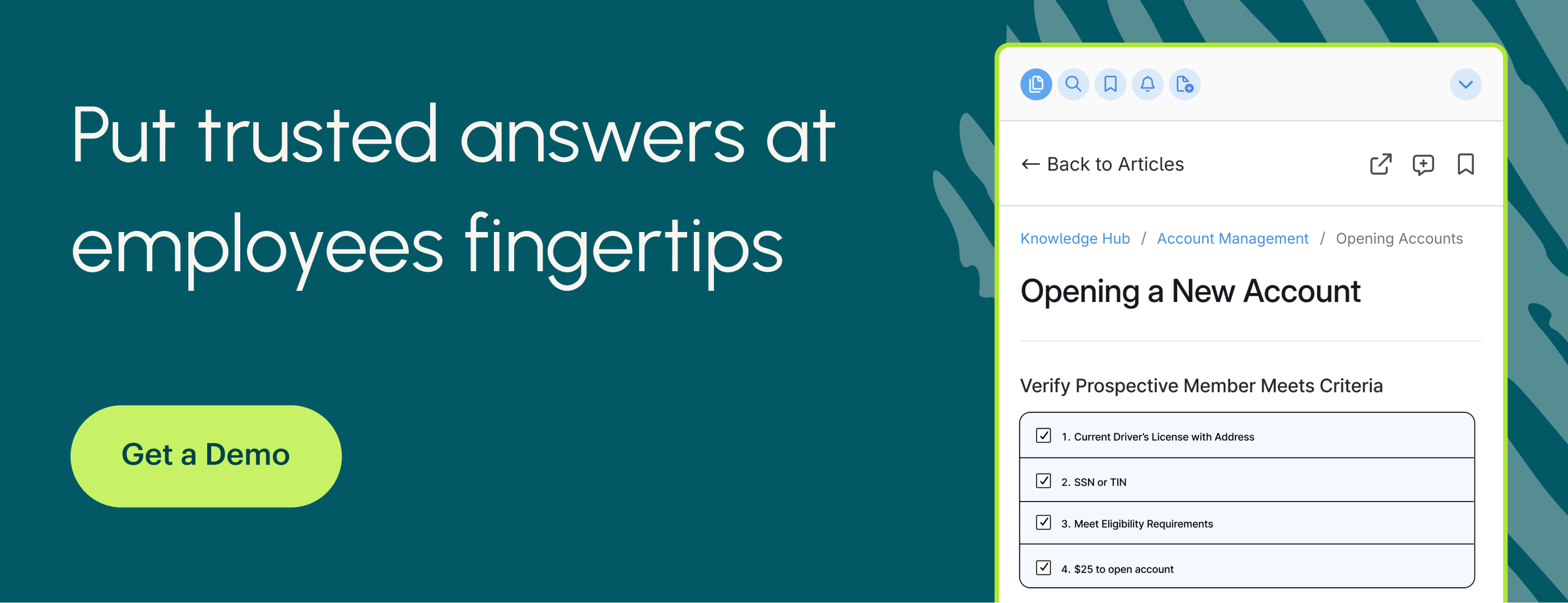
When implemented well, tellers can search for what they need, access a clear step-by-step guide, and follow it during the interaction.
For example, imagine a teller is helping a member’s family process a deceased account. Instead of escalating to a supervisor, they search “deceased account” and, within seconds, pull up a guide that walks them through each decision point: beneficiary status, account type, required steps, and next actions. They follow the guide while sitting with the member, keeping the interaction focused, empathetic, and accurate.
This changes how work feels and how it performs.
Employees become more confident because they know they can handle any situation, even if they have not seen it before. Performance becomes consistent because everyone is following the same procedures. And interactions improve because tellers can focus on the member instead of the process.
Operationally, everything becomes more stable. Senior staff are no longer overwhelmed with questions. New hires ramp faster. Members are served more quickly and consistently.
Instead of a fragile system dependent on memory and individuals, the credit union operates with a reliable, scalable framework built for the moment of performance.
Key takeaways
- Credit union tellers struggle because they are expected to memorize complex, constantly changing procedures while serving members in real time
- The issue is systemic, not a people problem, and leads to credit union teller errors and inconsistent performance
- The cost shows up in member experience, error remediation, lost productivity, and slow onboarding
- Traditional solutions like more training or more documentation do not address real-time execution
- The solution is shifting to real-time performance support, where employees can find and follow procedures in the moment
Want to see what this looks like in practice?
If this sounds familiar, the next step is seeing how credit unions are solving this problem in real environments.
- Explore: ScreenSteps for credit unions
- Watch: A short demo of how teams use ScreenSteps to support tellers in real time
Whether you are trying to reduce errors, speed up onboarding, or deliver a more consistent member experience, seeing the system in action is the easiest way to understand what is possible.