

Every customer-facing employee in a regulated industry lives inside what we call the moment of performance: the instant they have to answer a question, execute a task, or solve a problem while someone is waiting.
In this moment, there are three possible outcomes:
- The employee knows how to do it and does it right
- They think they know how to do it and get it wrong
- They're unsure and have to escalate
The third outcome is the expensive one, and most leadership teams misdiagnose why it happens.
Escalation is often a liability shield, not an information gap
A contact center agent recently told us why he escalates mid-call: not because he can't find an answer, but because he wants someone else on record for the decision. In his words, he's covering himself in case there's a mistake.
That's not a knowledge problem. Your employees are just managing risk to the customer relationship, to their compliance record, and to their own jobs, all at the same time. Escalation is the cheapest way to offload that risk, even if the answer was right in front of them.
We go deep on this, and on why chatbots solve retrieval but not confidence in this blog post.
Training doesn't scale to your highest-stakes work
Daily tasks get reinforced constantly through repetition. Training works there. But regulated operations carry a long tail of tasks that surface weekly, monthly, or quarterly (like a beneficiary change after a customer's death). These are usually your highest-stakes moments, and training can't fix them. Nobody builds confidence on that few repetitions.
This is a framing problem, not a training problem.
Thomas Wedell-Wedellsborg makes the case in What's Your Problem?: "The way you frame a problem determines which solutions you come up with. By shifting the way you see a problem, that is, by reframing it, you can sometimes find radically better solutions."
The instinct is "train them more." For infrequent, high-stakes tasks, training was never the right problem to solve for. The solution has to carry weight training can't.
Most organizations are stuck at the wrong stage to fix this
We map knowledge maturity in three stages:
- Tribal: operations run on memory and word of mouth.
- Document: procedures exist, but no one can use them in real time.
- Guide: employees get structured, performance-ready guidance they actually follow under pressure.
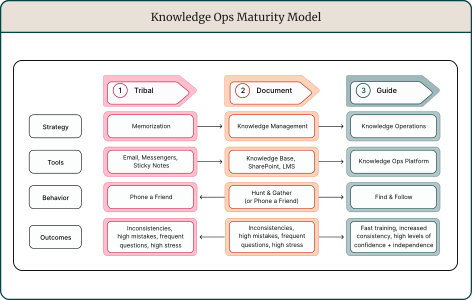
Most regulated organizations we talk to are stuck between Tribal and Document. That's the whole story behind their escalation volume.
Where to start
Two questions, before you invest in anything:
1. What is this actually costing you?
Find your highest-stakes, lowest-frequency tasks. Ask frontline employees what they do when one comes up. Add up what escalation and guesswork are costing you in supervisor time, response speed, and errors.
2. Does your current system stand a chance?
Pull up the documented procedure for one of those tasks. Ask an employee what stops them from using it live, in front of a customer. That answer is the real diagnosis.
Discussion guide for leadership teams
We built a discussion guide to help you run exactly this exercise with your team: a short PowerPoint template that walks you through identifying your highest-risk tasks, surfacing what's actually happening in the moment of performance, and pressure-testing whether your current system has a shot.
Download it here and run it with your team this week.